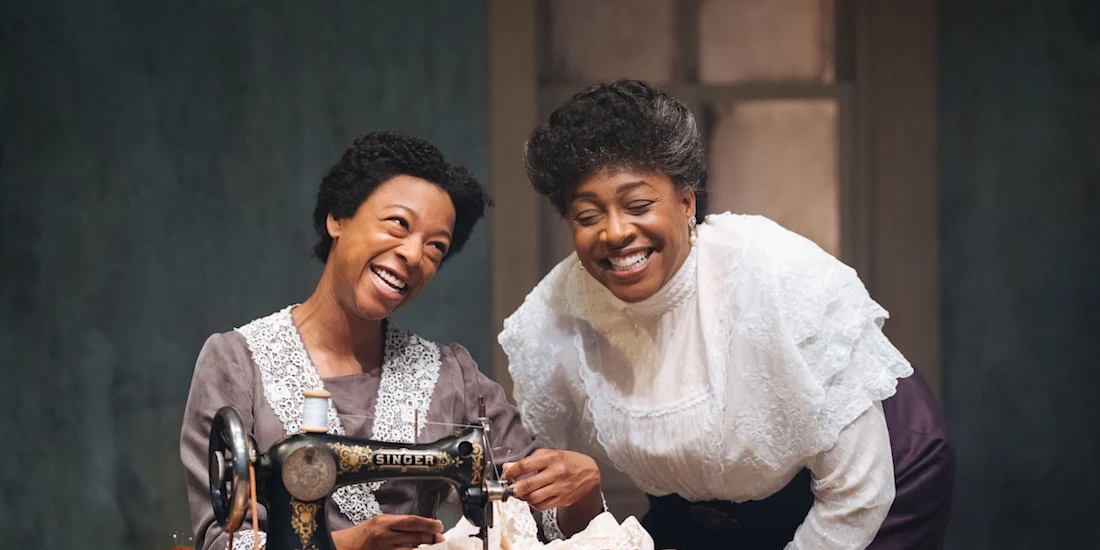
At first glance, Intimate Apparel, written by Pulitzer Prize winner Lynn Nottage and directed by Lynette Linton, seems like a tender piece set in 1906’s New York City. A quiet seamstress, Ester, stitches her way through the dreams and disappointments of a harsh world. However, as the play unfolds it reveals itself to be something far more subversive, a portrait of Black womanhood; longing, ambition and resilience as rich and as layered as the garments Ester creates.
Ester is unmarried at the age of 35 and lives by hope and the goodness she sees in others. Ester is neither a victim not a naive romantic. She is an everywoman, haunted by what could be, always seeing the good others but trapped by a world that sees her softness as expendable. The play has echoes of Cyrano de Begerac but without the flamboyance. Here letters and lace are used to express what the body cannot; desire, frustration and dignity.
What I found most wonderful is that as the play develops, the garments that Ester produces grow more elaborate and more symbolic. Through fabric Ester speaks. Her voice is sewn into every stitch.
The central performance by Samira Wiley is delicate, deliberate, just showing the tip of the iceberg, but does not dazzle instantly. It left me turning over Ester’s choices long after the curtain call. There’s a quiet power in that restraint, and a confidence in letting the silences do the talking. The supporting cast are all pitch perfect. I especially liked the dynamic between Ester and Mr Marks, some of the most beautiful scenes of forbidden love I’ve seen on stage all year.
It’s also thrilling to see a production that places a Black woman so firmly at its heart without apology or compromise. However, even with its five star reviews the theatre wasn’t sold out. That fact still bothers me. Why, in 2025, do we still see a ceiling when Black women take centre stage. What does it say about who theatre is “for”?
Intimate Apparel feels like a modern play in a vintage corset – soft spoken but unflinching. A historical drama that speaks straight our very modern ears. Ester, in all her quiet and radiant complexity, is the kind of protagonist we need more of: not flashy but unforgettable.
